Automated mobile heliometric survey
A complete field workflow — equipment package, QC and anomaly verification — that takes a soil-gas station to a georeferenced helium anomaly map.
- MS detection limit*
- 5 ppb
- He qualification level
- ~5 ppm
- Probe depth
- 0.5–1.5 m
- Field crew
- 4 people
Helium exploration by shallow soil-gas geochemistry
From a soil-gas station to a georeferenced helium anomaly map.
- 01 · SamplingSoil-gas probe
- 02 · Sample trainConditioning & flow
- 03 · AnalysisHPR-20 R&D MS
- 04 · RegistrationGNSS + field PC
- 05 · OutputQC + ΔHe map
Primary objective: quantify weak helium anomalies relative to the local atmospheric and soil-gas background — not merely detect the presence of He.
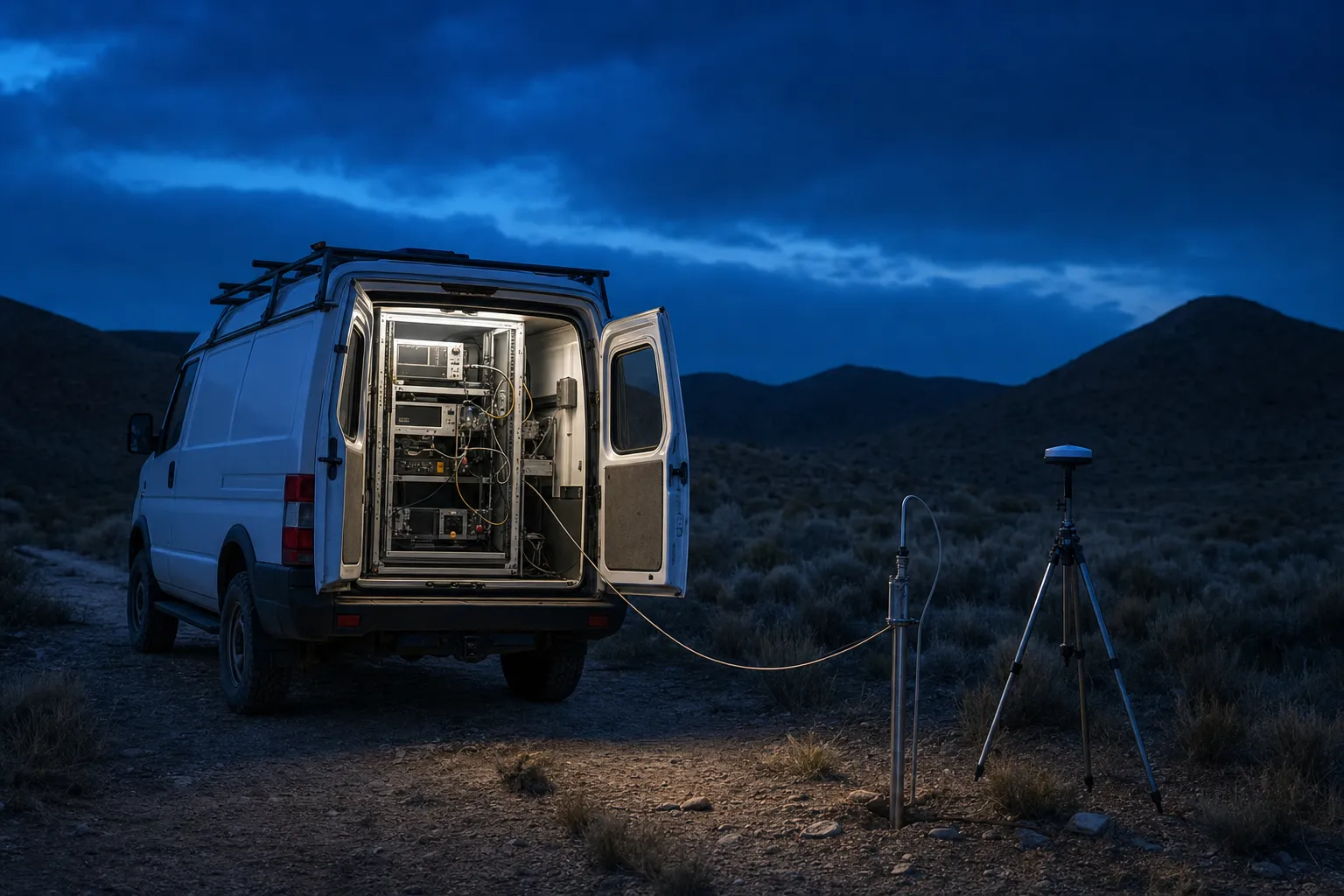
01Measurement philosophy
Survey objective and measurement philosophy
Helium exploration requires quantitative stability around the natural background level.
01 · Background
Establish the local He baseline using ambient-air checks and low-anomaly soil-gas stations.
02 · Anomaly
Measure absolute He concentration and calculate ΔHe relative to a controlled reference / background.
03 · Confirmation
Repeat anomalous stations, apply QC flags and verify persistent targets with longer-term monitoring.
Critical procurement principle
A low instrument detection limit is not enough. Vendor qualification must demonstrate accuracy, repeatability and drift performance at approximately 5.0–5.5 ppm He using certified reference mixtures.
02Field workflow
Seven steps at every station
A standardised station sequence is essential for reproducible anomaly mapping.
- 01PositionNavigate to station; record GNSS, terrain and metadata.
- 02ProbeInstall a gas-tight probe, typically 0.5–1.5 m below ground.
- 03PurgeRemove dead volume; verify stable flow and no line leakage.
- 04ConditionFilter particles; control moisture and condensation without He loss.
- 05AnalyseContinuous He measurement, repeated until a stable plateau.
- 06QCReference, blank and duplicate checks; flag unstable stations.
- 07MapStore coordinates, He, ΔHe and environment; update the field map.
Target productivity is validated during the pilot. In practice, probe installation, purge and stabilisation, station spacing and QC control daily output more than analyser speed.
03Core analytical system
Core analytical system — Hiden HPR-20 R&D
The central real-time gas analyser, subject to a helium-specific factory acceptance test at ~5 ppm.
- Analyser
- Triple-filter quadrupole mass spectrometer
- Detection limit
- 5 ppb ultimate*
- Sampling
- Continuous gas sampling
- Sample flow
- Configurable, < 1 to > 20 mL/min
- Software
- MASsoft Professional + external I/O
- Configuration
- Benchtop / mobile
* Subject to spectral interference.
Why it fits the survey concept
- Real-time response enables stabilisation-based station acceptance rather than a single grab reading.
- Mass-selective measurement supports multi-gas context and interference assessment.
- External I/O synchronises GNSS, pressure, temperature and other sensors with MS data.
- Vehicle installation keeps the analytical core in a controlled environment while the probe stays in the field.
Mandatory qualification: certified 4.5 / 5.0 / 5.2 / 5.5 / 6 / 10 ppm He mixtures; replicate measurements and a long-term drift test.
04Sampling train
Soil-gas sampling and sample-conditioning train
The sampling train must preserve weak He anomalies and prevent air ingress, moisture problems and memory effects.
- A
Probe set
5–10 reusable stainless-steel probes; replaceable tips; insertion tools; depth marks.
- B
Gas-tight line
Low-permeability tubing, quick-connect fittings, isolation valves and spare seals.
- C
Particulate control
Replaceable inline filter upstream of analytical components.
- D
Moisture control
Water trap / condenser strategy selected to avoid helium fractionation or contamination.
- E
Pump + flow
Low-leak pump, flowmeter / MFC, vacuum indication and blocked-line alarm.
- F
Selector
Manual or automatic valve manifold for sample / ambient / zero / span gas.
A field leak check and a controlled purge volume are part of every station procedure.
05Equipment package
Complete equipment package — one mobile field crew
Base configuration for production work; quantities can be adjusted after pilot testing.
01Analytical core
1 × HPR-20 R&D; selected MS inlet; scroll pumping; MASsoft; interface cables.
02Sampling kit
10 × soil-gas probes; insertion / extraction tools; spare tips; low-permeability tubing; valves.
03Flow & conditioning
Sampling pump; flow controller / flowmeter; vacuum gauge; filters; moisture traps; manifold.
04Calibration & QC
Certified zero and He standards around 5 ppm and higher; regulators; lines; leak-test accessories.
05GNSS / navigation
GNSS receiver (sub-metre preferred, RTK optional); antenna / pole; station navigation software.
06Field computing
Rugged Windows laptop / tablet; survey database; automatic station ID; GIS / CSV export.
07Environmental sensors
Barometric pressure, ambient temperature / RH, soil temperature; optional soil moisture.
08Power system
230 VAC + vehicle 12/24 VDC inverter / UPS; surge protection; backup battery.
09Mobile laboratory
4×4 / van; vibration-isolated instrument rack; ventilation; clean, dry analytical zone.
10Spares & consumables
Filters, seals, tubing, connectors, pump kit, probe tips, tools, labels, backup sample vials.
06Mobile laboratory
Mobile laboratory layout
The dirty, wet field interface is kept apart from the clean analytical and control zones.
Zone A
Field / wet zone
- · Probe tools and consumables
- · Sampling-line entry panel
- · Filters / primary moisture protection
- · PPE and decontamination kit
Zone B
Analytical zone
- · HPR-20 R&D
- · Vibration isolation
- · Stable power
- · Controlled temperature / ventilation
Zone C
Control / power
- · Rugged PC / data acquisition
- · GNSS interface
- · UPS / inverter
- · Calibration-gas secure rack
- · Reference sensors
- · Daily backup / communications
Design rule: keep dust, wet tools and open soil-gas connections away from the mass spectrometer and calibration hardware.
07Calibration
Calibration and QA/QC programme
Weak anomalies are credible only when analytical drift and sampling artefacts are controlled.
Start of day
Zero / ambient check; reference gas; line leak check; flow verification.
During survey
Ambient reference at a defined interval; duplicates; repeated anomaly stations; QC flags.
End of day
Reference gas repeat; drift review; database completeness; raw-data backup.
FAT / periodic
Certified He standards around 5 ppm; ≥ 10 replicates at critical concentrations; stability test.
Critical standards 5.0 / 5.2 / 5.5 ppm — at least 10 replicate measurements each.
08Data acquisition
Data acquisition and real-time field QC
Every analytical result is tied to position, sampling conditions and QC state.
- Station
- Survey ID, station ID, date / time, operator
- Position
- Lat / lon / elevation, GNSS quality
- Sampling
- Probe depth, purge time / volume, flow, vacuum
- Helium
- He ppm, stabilised value, ΔHe, replicate statistics
- Context gases
- Optional H₂, CH₄, CO₂, O₂, N₂ / Ar
- Environment
- Pressure, ambient T / RH, soil T, optional moisture
- QC
- Calibration status, blank / reference, duplicate, flags
- Output
- CSV + GIS layer + raw MS file + daily QC report
Stations are accepted automatically only once predefined stability criteria are met; anomalous or unstable stations are highlighted immediately for repeat measurement.
09Second-level verification
Second-level verification — SurfMoG®-He
Autonomous near-surface monitoring after reconnaissance tests whether anomalies persist through time.
- Near-surface soil-gas monitoring
- Approx. 1 m installation depth
- Standalone logger + battery
- Wireless / IoT data transmission
- Temperature + optional humidity
- Large local data memory
- 01Reconnaissance mobile survey
- 02Rank anomaly targets
- 03Install selected SurfMoG-He
- 04Monitor days to weeks
- 05Persistent anomaly?
Purpose: separate a stable geological signal from short-term atmospheric, barometric, soil-moisture and sampling variability.
Vendor helium-sensor range and precision are confirmed for each project.
10Field crew
Field crew and responsibilities
A compact crew operates efficiently when station preparation and analysis run in parallel.
01
Crew lead / geochemist
Survey design, QC decisions, anomaly ranking, daily technical report.
02
Probe technician
Station preparation, probe installation, leak check, purge, line maintenance.
03
Analyser / data operator
HPR-20 operation, calibration, stability acceptance, database and backups.
04
Driver / field assistant
Navigation, safety, equipment movement, consumables, optional second probe team.
While one station is analysed and logged, the next probe location is prepared — without compromising leak checks or QC.
11Deployment
Deployment sequence and deliverables
The analytical chain is qualified first; production scales up only after field repeatability is demonstrated.
- 1RFQ / vendor reviewConfirm complete configuration and helium performance near 5 ppm.
- 2Bench test / FATCertified standards, blind samples, replicate precision and drift.
- 3Pilot survey1–2 profiles; duplicates; background stations; environmental controls.
- 4Method freezeFinalise probe depth, purge, stability threshold and QC frequency.
- 5Production surveyGrid / profile acquisition with daily QC and anomaly ranking.
- 6VerificationRepeat targets + SurfMoG-He monitoring on selected anomalies.
Core deliverables
- Validated station database
- Raw analytical files
- QC report
- He and ΔHe maps
- Anomaly ranking
- Repeat / monitoring recommendations
Rental enquiry
Planning a helium survey?
Tell us the area, the objectives and the timeline. We will propose the equipment package, crew and QA/QC programme to match.