Skip to content

An independent processing house with its own compute

GEOGALS is a seismic data processing company, incorporated in 2011 in Tallinn, Estonia. As an independent service provider, GEOGALS uses modern processing software and powerful hardware to process large volumes of 2D and 3D seismic data acquired in various geographic and geologic settings — land, transitional and marine environments.

CPU cores
4,864
Usable storage
1.5 PB
CUDA cores
61,440
Established
2011

01People

15–20 specialists, decades in the field

GEOGALS employs 15–20 specialists — geophysicists, geologists and IT staff with a strong professional record. The combined expertise of our people and decades of experience across a wide range of petroleum provinces allow us to carry out projects of any complexity and size. We are experts in cutting-edge procedures such as 3D SRME, WEMA, 5D regularisation, RTM, FWI, Q-PSDM and ES360.

The company head office and its main Processing Centre are located in Tallinn, Estonia. Regional offices are located in the United Kingdom, Dubai (UAE), Manama (Bahrain), Tbilisi (Georgia) and Asuncion (Paraguay).

  • 3D SRME
  • WEMA
  • 5D regularisation
  • RTM
  • FWI
  • Q-PSDM
  • ES360
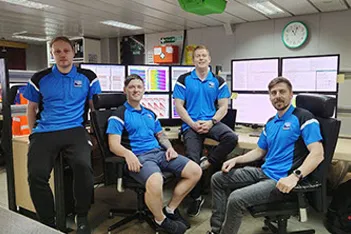
GEOGALS onboard QC team in the vessel instrument roomREAL PHOTO
Onboard QC team — acquisition and processing work as one crew.

02Software

Licensed tools, chosen per project

The main software tool for marine data processing is the REVEAL package from Shearwater. We also use software products from other developers — Paradigm, Flatirons, RadExPro — depending on client requirements and the complexity of the geological setting.

  • 01

    Shearwater REVEAL

    Primary marine processing

    licensed

  • 02

    Flatirons

    Specialist workflows

    licensed

  • 03

    RadExPro

    Real-time onboard QC

    licensed

  • 04

    Paradigm

    Interpretation & imaging

    as required

03Tallinn processing centre

Compute we own, not capacity we rent

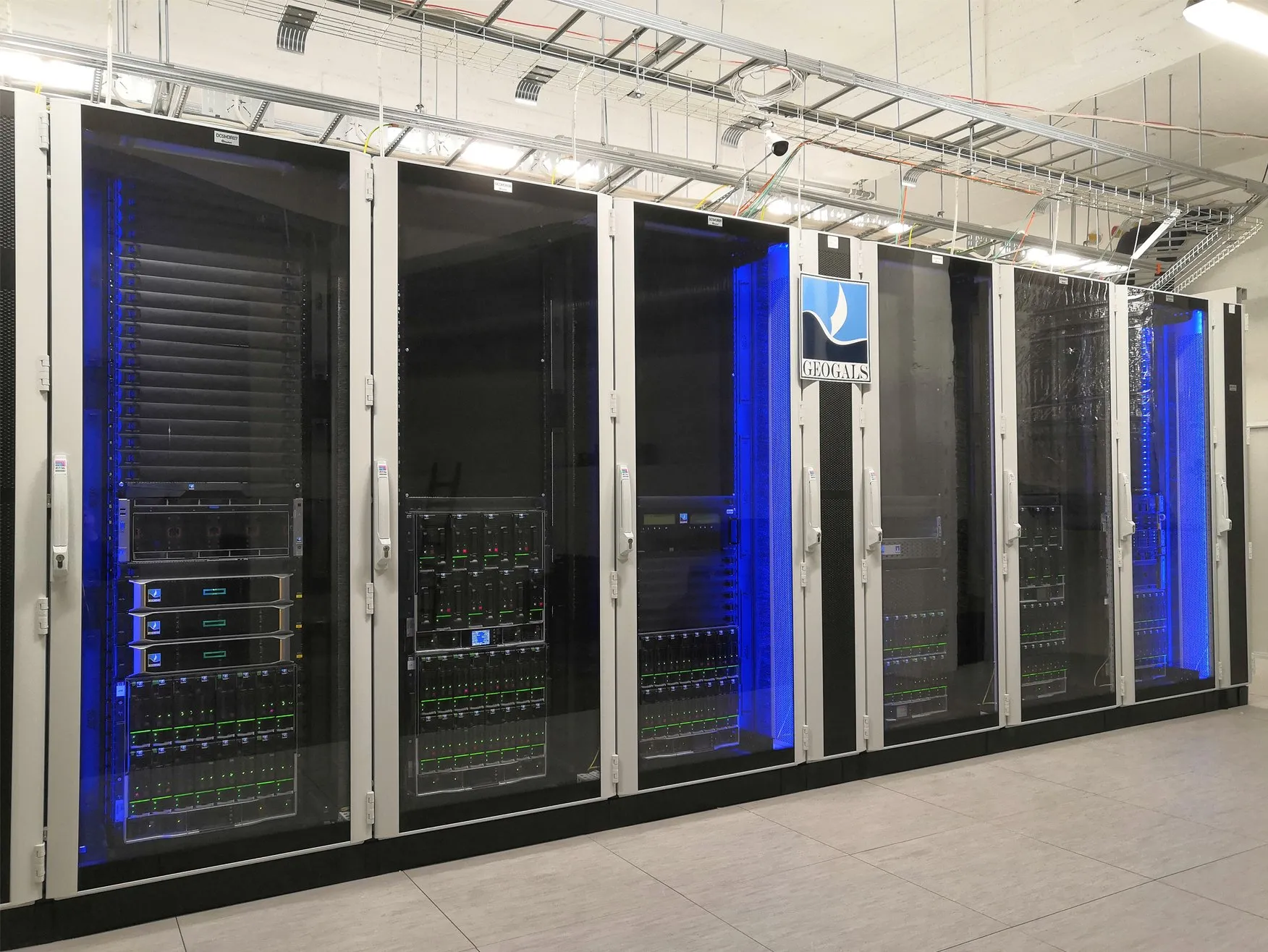
The primary data centre, located in Tallinn, provides a high-performance computing environment comprising more than 4,800 CPU cores and over 1.5 PB of usable storage capacity. The IT infrastructure is built on industry-standard, enterprise-grade hardware and software technologies.

GEOGALS server racks in the Levira data centre, TallinnREAL PHOTO
Networking
Arista 25G/100G Ethernet switching and Mellanox FDR InfiniBand fabric
Compute
HPE BladeSystem c7000 (Gen8/Gen10) and HPE DL-series servers
Operating systems
CentOS Linux 7.9 and Rocky Linux 8.10
Workload management
Slurm workload manager
Parallel filesystem
BeeGFS distributed filesystem
Orchestration
SaltStack and Ansible

Cluster schedule · as commissioned

01

Management infrastructure

Highly available virtualisation cluster based on Proxmox VE 8.3

  • · 3 × HPE DL380 Gen10 servers, 192 GB RAM each
  • · Shared enterprise storage: HPE MSA 2052
  • · High-performance switching: Arista DCS-7060SX2

HA virtualisation layer

02

CPU Cluster 1

4 × HPE BladeSystem c7000 Gen3 chassis, 16 compute nodes each

  • · HPE BL460 Gen10
  • · Intel Xeon Gold 6240 — 36 cores per node
  • · 384 GB DDR4 RAM
  • · 4.0 TB SSD storage

64 nodes / 2,304 CPU cores

03

CPU Cluster 2

8 × HPE BladeSystem c7000 Gen2 chassis, 16 compute nodes each

  • · HPE BL460 Gen8
  • · 2 × Intel Xeon E5-2680 v2 — 20 cores per node
  • · 256 GB DDR3 RAM
  • · 3.2 TB SSD storage

128 nodes / 2,560 CPU cores

04

GPU Cluster

6 × Supermicro SYS-1028GR-TR GPU servers

  • · 2 × Intel Xeon E5-2697A v4 — 30 cores per node
  • · 256 GB DDR4 RAM
  • · 2 × NVIDIA V100S GPUs per node

61,440 CUDA cores / 7,680 Tensor cores

05

Distributed storage (BeeGFS)

Parallel filesystem across dedicated storage nodes

  • · 8 storage nodes with 14 storage targets
  • · Dedicated metadata servers with NVMe-backed storage
  • · Centralised management server
  • · High-speed FDR InfiniBand storage network

over 1.5 PB usable

06

Archival storage

Hybrid long-term data retention

  • · NetApp FAS2620 with DS460C disk shelf — 344 TB
  • · IBM 3592 tape library — E05, E07, E08 and LTO-6 formats

344 TB disk + tape
04Availability & reliability

The infrastructure is designed to ensure a high level of availability, fault tolerance and service continuity.

  • Redundant architecture

    Critical components — compute nodes, storage systems and network infrastructure — are deployed with redundancy to eliminate single points of failure.

  • HA virtualisation layer

    The Proxmox VE cluster supports live migration and automatic restart of virtual machines in case of hardware failure.

  • Resilient storage

    The BeeGFS distributed filesystem ensures data replication and fault tolerance across multiple storage nodes.

  • High-speed networking

    Redundant Arista switching and InfiniBand fabric minimise bottlenecks and ensure low-latency communication.

  • Monitoring and alerting

    Continuous infrastructure monitoring enables proactive detection and resolution of potential issues.

  • Planned maintenance

    Maintenance activities are scheduled to minimise service disruption and are communicated in advance.

05Security

The infrastructure is designed in accordance with industry best practices to ensure the confidentiality, integrity and availability of data and services.

  • Network security

    Segmentation of management, storage and compute networks; controlled access via firewalls and ACLs.

  • Access control

    Role-based access control across all systems. Administrative access is restricted on the principle of least privilege.

  • Authentication

    Centralised authentication mechanisms — FreeIPA integration — are used where applicable.

  • Data protection

    Data is protected through access policies, filesystem-level controls and secure storage configurations.

  • Secure administration

    All administrative access is performed over secure protocols such as SSH and HTTPS.

  • Patch management

    Regular updates and security patching are applied to operating systems and software components.

  • Audit and logging

    System activity and access logs are collected and retained for auditing and incident investigation.

  • Backup and recovery

    Regular backups and archival procedures ensure data recoverability in case of failure or data loss.

06Facility

Levira data centre, Tallinn

The data centre of Levira in Tallinn is a highly reliable and secure infrastructure facility, compliant with international standards for quality and information security — ISO 27001, ISO 9001 and ISO 14001 — as well as national ISKE requirements.

The physical and engineering infrastructure is designed in accordance with high availability and business continuity principles. Full redundancy is implemented across all critical systems, including power supply (multiple independent feeds, UPS and diesel generators), cooling systems and network infrastructure. The facility architecture ensures fault isolation and resilience against external disruptions.

The data centre demonstrates a high level of operational reliability and is designed to support strict SLA commitments, backed by extensive experience in delivering mission-critical services for the telecommunications and media industries.

The network infrastructure follows a carrier-neutral model, with connectivity to multiple independent providers and diverse fibre routes.

More on the facility at levira.com ↗

  • ISO 27001

    Compliant

  • ISO 9001

    Compliant

  • ISO 14001

    Compliant

  • ISKE

    Compliant

ENERGEO Alliance Contributing Member 2025 badge

ENERGEO Alliance

Contributing Member, 2025

Start a project

Send us the survey. We will tell you what the data can give you.

Acquisition parameters, data volume, objectives, timeline. Our geophysicists come back with a processing sequence and a realistic view of the result — not a brochure.