Skip to content

From raw field records to an image you can interpret

GEOGALS is a company with a strong seismic data processing background and work-at-sea background. We provide best-in-class time processing, depth imaging, structural interpretation, and best-in-class onboard quality control services and onboard fast-track time processing.

Environments
Land · TZ · Marine
Surveys
2D / 3D
Imaging
Time & depth
CPU cores in-house
4,864

We process and re-process land, TZ and marine seismic data by combining the latest processing software with experienced geophysicists and efficient hardware. Our experienced onboard and onshore processing teams provide the expertise and service to achieve the highest quality 2D and 3D imaging in all geological environments.

GEOGALS's main processing hubs are in the EU, but we have the flexibility to establish project-specific centres close to our clients' offices as required.

01Processing service

Amplitude Friendly Processing

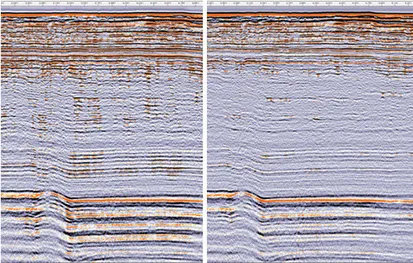
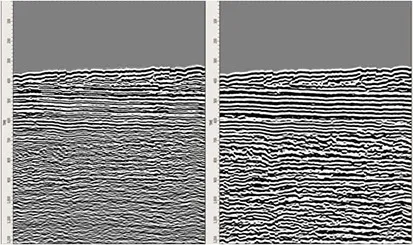
Maintaining the amplitude–frequency characteristics of the signal is one of the critical conditions for reliable kinematic and dynamic interpretation. To effectively extract the signal, GEOGALS specialists employ flexible adaptive noise attenuation techniques that optimally preserve the original distribution of amplitudes and frequencies.

01 · Amplitude Friendly ProcessingREAL DATA
Amplitude friendly processing result
Processing result from a GEOGALS project.

02Processing service

Multiple Reflections

Multiple reflections — the energy of waves reflected from more than one interface — bring a high degree of uncertainty into structural interpretation and seismic reservoir characterisation. The presence of multiples complicates identification of reflections from target horizons and prevents detailed interpretation of structural and stratigraphic elements. Our processors use the most innovative methods to attenuate multiples of different nature, both before and after migration, including SRME and WEMA.

02 · Multiple ReflectionsREAL DATA
Seismic section before and after multiple attenuation
Processing result from a GEOGALS project.

03Processing service

Noise Attenuation

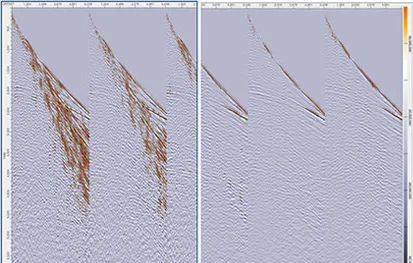
Noise attenuation tackles a wide range of noise including linear refractions and direct arrivals, ground roll, swell noise, spikes, cable jerk, random noise and seismic interference.

03 · Noise AttenuationREAL DATA
Seismic section before and after noise attenuation
Processing result from a GEOGALS project.

04Processing service

Data Merging and Regularisation

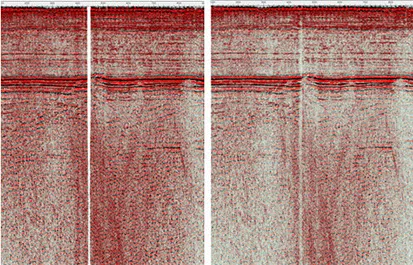
One project may contain several seismic surveys obtained in different geological environments using different acquisition designs and parameters. Correct integration and regularisation of heterogeneous seismic data sets is a key determinant of the effectiveness of all subsequent processing procedures. Our processors have decades of experience in the balancing and regularisation of 3D seismic data sets obtained under different conditions.

04 · Data Merging and RegularisationREAL DATA
Merged and regularised 3D seismic data sets
Processing result from a GEOGALS project.

05Processing service

Time Imaging

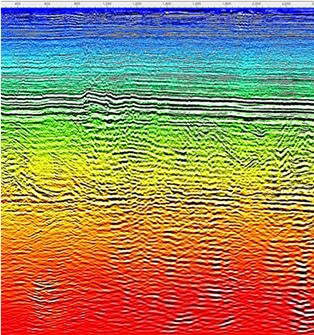
TZ, land and marine time imaging is an integral part of our processing and imaging services. Velocity model building and imaging are state of the art. Since the result of time and depth migration strongly depends on the quality of the velocity model, migrated depth gathers provide optimal data to refine the velocity. The seismo-geological features of a particular area and survey design parameters dictate the choice of the optimal migration algorithm — often to extremely tight deadlines. Extensive experience with various migration algorithms allows us to select and recommend the most effective option for a specific geological setting.

05 · Time ImagingREAL DATA
Time-migrated seismic section with velocity overlay
Processing result from a GEOGALS project.

06Processing service

De-Ghosting and Designature

De-ghosting and designature techniques aim to create a simple and robust seismic wavelet to ensure reliable subsurface information can be extracted from the recorded data. The seismic energy emitted by the sources consists of two constituents: one propagates directly downwards into the subsurface, the second — the source ghost — first propagates upwards to the sea surface before being reflected to propagate as a down-going wavefield. Source de-ghosting generates single-event responses of the sources from the doublet responses recorded due to sea-surface reflections.

06 · De-Ghosting and DesignatureREAL DATA
Seismic section after de-ghosting and designature
Processing result from a GEOGALS project.

Delivery

Sequenced in parallel, not in a queue

Specialists and resources are chosen according to the project timeline and are never shared between projects. Further processing steps begin as soon as possible and run in parallel — so the client can take results earlier, or use the time for extra products and recommendations.

Start a project

Send us the survey. We will tell you what the data can give you.

Acquisition parameters, data volume, objectives, timeline. Our geophysicists come back with a processing sequence and a realistic view of the result — not a brochure.